
Less Instructing, More Teaching
Sports Coach as Educator #1

I’m always trying to read books that stretch my thinking about coaching and learning. I recently read two books that stretched me a lot so I am writing about concepts from those books for two reasons. First, I don’t think these books are widely read so if I don’t share them with you, I don’t know that anyone else will. Second, selfishly, writing about these concepts helps me think through what they mean to me and how I could incorporate them into my own coaching. I see these as opportunities to wrestle with some big ideas in front of others. I hope you find these explorations both interesting and edifying.
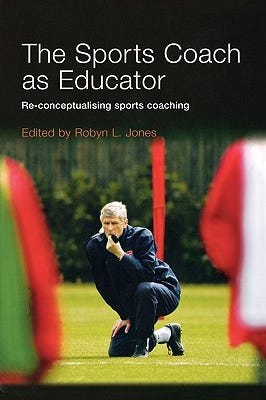
The concept below comes from The Sports Coach as Educator edited by Robyn Jones1. Specifically, this concept is taken from chapter seven, “Athlete learning in a community of practice: Is there a role for the coach?”, written by James Galipeau and Pierre Trudel.
I was inspired by this passage from the chapter:
One way for coaches to better understand the complexities of athletes’ lives is to adopt a coaching style based on the concept of pedagogy instead of assuming a constrained role of ‘teacher’. Referring to the work of Savater (1997) on the historical use of the word ‘pedagogy’, Jones et al. (2004) explain that the scope of the work of a pedagogue was once much more comprehensive than simply being a teacher: ‘In contrast with the teacher…who was merely responsible for delivering specific instrumental knowledge, the pedagogue had a broad-ranging and holistic role in the moral development of a young person’ (Jones et al. 2004: 96). This description of pedagogy fits our views on the multiple roles that coaches play on a team as opposed to simply being the person who teaches skills and drills. (Jones, 2006: 91-92)
There are many synonyms for “educator” and many of those terms are used interchangeably. In the passage above, Galipeau and Trudel distinguish between two such terms, pedagogue and teacher. While the authors write only a couple paragraphs about the subject, I want to delve into this difference in more detail. But, to do so, I’m going to change the words describing the roles. Although I’m using different names, they correspond to the same roles. Let’s consider what it means to be an “instructor” and what it means to be a “teacher”.
Instructors, in my opinion, instruct. They give instructions to others who carry out those instructions. I’m not saying it’s easy work. Good instructors put a lot of care and attention into crafting their instructions. Those instructions can be intricate, they can be detailed, they can be layered. Instructors need instructions for individual athletes and for teams, they need instructions for the present but they also need ones that set up future instructions. But, in the end, they’re still just instructions.
Instructions are what you get when you’re building IKEA furniture. They work because everyone everywhere gets the same materials and uses the same tools to work towards the same product. It’s all self-contained. Instructors assume their instructions are universal, that they work the same for all recipients at all times. Instructors assume that what to coach and how to coach are the most important topics to address. They also assume that who they coach matters far less, because recipients of coaching only need follow the instructions they are given.
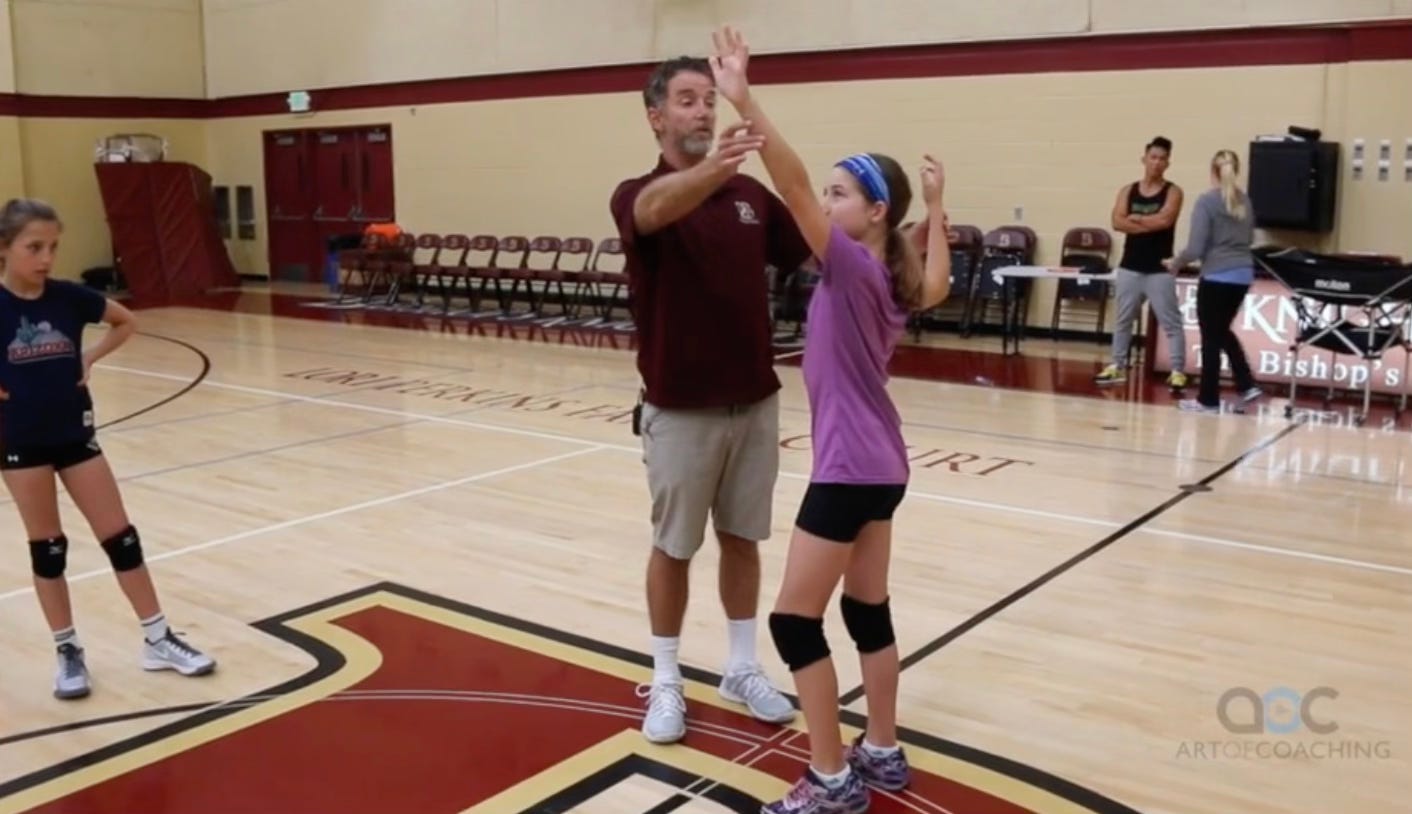
But just using instruction limits learners. The who matters. The who affects learning. Instructions change actions but learning changes behavior. Changing behavior doesn’t just change action, it inevitably changes who you are. Changing behavior changes who learners are because they have to change their relationship with what they’re doing. Think about flow for a minute. Flow can be defined as “the melting together of action and consciousness; the state of finding a balance between a skill and how challenging that task is.” Flow requires bringing the self into the actions. Instructions can’t tell people how to bring themselves into what they do. That’s what teaching is for.
Teachers seek to understand who is being coached. Who the learner is and who they’re trying to be shapes their behaviors. Their identity shapes what they see as possible and worth pursuing and how to pursue it. Teachers notice what learners in their care can do, what they can’t do, and what they try to do when faced with new situations. Teachers view teaching as figuring out how learners engage with situations and tailoring their support to match the behaviors they see. They have a bigger, more complete picture in mind than the learner does and they guide the learner towards unexplored territory. As a result, the learner expands their beliefs about what is possible and worth pursuing and how to pursue it. In short, through learning they change who they are.
But there’s more to it than just what happens within the learner. Galipeau and Trudel write that
Understanding who is being coached as well as who is coaching could help lead to better coaching practices, better athlete–coach relationships, increased satisfaction and, ultimately, better athletic performance. (Jones, 2006: 91, emphasis mine)
The who affects not just learning but also teaching. Who you are matters. Teaching requires more than just observing and adapting to a learner. Just like learners, teachers’ behaviors are influenced by their beliefs and values. An educator shifts from instructing to teaching when they embrace and integrate their unique beliefs and values into their practice.
Embracing your beliefs and values starts with understanding what they are. But it can’t stop there. Many coaches compose mission statements or draft coaching philosophies. But, if you’re not careful, those just become instructions on how to coach instead of becoming coaching behaviors. To illustrate, I’ll quote John Lyle from a different text, The Coaching Process2:
There is a temptation to characterize the philosophy as ‘this is what I think coaching should be like’, but this is not appropriate. Such a statement would be a statement of aspiration, and would say nothing about the reality of the coach’s practice. Therefore, it would be more appropriate to think of the philosophy as ‘these principles guide my coaching practice’. (Cross and Lyle, 1999: 30-31)
Lyle is reminding you that it’s not enough to say what coaching “should” be like, you have to show your work. Your behaviors have to connect what you believe with what you actually do. That’s what makes what you do teaching. Teaching can’t be just following someone else’s instructions or someone else’s blueprints. Teachers don’t say, “I’m doing this because a coach I respect does it.” Teaching reflects what the teacher believes is possible for them as a teacher just as much as it reflects what they believe is possible for the learners in their care. Teachers say, “I’m doing this because I believe it helps me be the best coach I can be.”
Notice the beliefs I’m talking about aren’t related to what you teach. That’s rooted in Galipeau and Trudel’s description (the opening quote above) of not simply teaching skills and drills. There aren’t “best” skills and drills but there are behaviors that work the best for you and in your present context. You need to think about how to be the best coach you can be within the context of your current team. Being your best self helps you connect with the people you coach. Teaching and learning are social and behavioral endeavors. Being the best coach you can be is being the best teammate you can be, which helps the team you’re part of be the best it can be.
The difference between an instructor and a teacher is that teachers acknowledge they aren’t working with pieces, but with people. Instructing assumes what matters much more than who. Teaching assumes that who teaches and who learns have profound impacts on what can be taught and how. Either way, you’re educating. Choose what kind of educator you wish to be.
Jones, R. L. (2006). The Sports Coach as Educator: Re-conceptualising Sports Coaching. Routledge.
Cross, N. R., & Lyle, J. (1999). The Coaching Process: Principles and Practice for Sport. Butterworth-Heinemann.