
Power, Power, Everywhere, Nor Any Stop to Think (part 2)
Sociology of Sports Coaching #1.2

(Apologies to Samuel Taylor Coleridge for destroying his classic line)
I’m always trying to read books that stretch my thinking about coaching and learning. I recently read two books that stretched me a lot so I am writing about concepts from those books for two reasons. First, I don’t think these books are widely read so if I don’t share them with you, I don’t know that anyone else will. Second, selfishly, writing about these concepts helps me think through what they mean to me and how I could incorporate them into my own coaching. I see these as opportunities to wrestle with some big ideas in front of others. I hope you find these explorations both interesting and edifying.
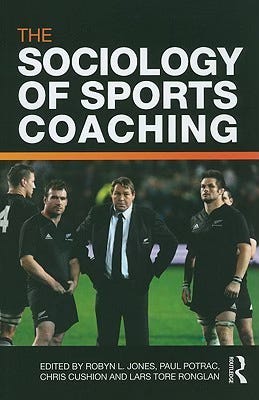
The concept below comes from The Sociology of Sports Coaching edited by Robyn Jones, Paul Potrac, Chris Cushion, and Lars Tore Ronglan1. Specifically, this concept is taken from chapter three, “Michel Foucault: Power and discourse, The ‘loaded’ language of coaching”, written by Jim Denison.
I ended part 1 saying it’s virtually impossible for me to coach purely subject matter when I see power everywhere. I can’t watch others coach and only see how they coach skills while ignoring how they use power. You are never teaching just subject matter. You are always exercising control and, therefore, teaching others how to respond to that control.

Many coaches are aware of how they use power only in explicit situations. They know they’re demonstrating power when they impose punishments. They know they’re demonstrating power when they make decisions that could be either given to players or made with player input. They are far less aware of how they use power at other times. Remember power influences what others can think, do, and be in spaces they share with you. Who gets to make decisions, both during and outside of practice and play? Are all players wearing the same outfits at practice? While the players may get to choose what they actually wear, whose choice was it to match in the first place? Why is matching important? Who does most of the talking in huddles? What’s the ratio of questions to statements or to requirements? These are all expressions of power because they are all rules, whether explicit or implicit. They all speak to what you will support players thinking, doing, and being.
Discourses and power are intricate and many-layered. It’s possible to give with one hand while taking away with the other; to appear to acknowledge the power of others while also dismissing that power. I knew a coach with an “open door” policy and they regularly met with players who had ideas and concerns. Allowing such meetings is a one way of sharing power. That same coach would often use those meetings to listen to those ideas and concerns and then explain to players why their ideas were inadequate or why their concerns were invalid. The coach could still say they listened to the players, but they also influenced the players to think, do, and be exactly what they wanted the players to be. The coach made space for players to express themselves while simultaneously negating any sense of empowerment they may have hoped for as a result of their expression. The coach was able to do this because a larger discourse supports such behavior.
In part 1, I mentioned that coaching is its own endeavor but it is simultaneously located within a larger discourse. The specific coaching you do is nested within the discourse of sport coaching in general. It is nested within the discourse of the community where you coach, like the city you’re in and/or the league you coach in. Those discourses set expectations for what kinds of coaching and playing behaviors are valued. Others, often people not even present when you coach, are influencing what you (and players) can think, do, and be. Those larger discourses can facilitate certain behaviors while inhibiting others.
Coaches are, more often than not, liberated by larger discourses that affect coaching. Players are, more often than not, limited by larger discourses that affect coaching. For instance, in my “open door” example above, notice who has the power around having meetings. The coach is free to determine the “appropriate” forms of communication. The player is limited to the forms the coach chooses. But how was that balance determined? We are simultaneously subject to the discourses we are part of while also shaping those discourses as well.
We shape discourses by how we set rules for others and for ourselves. We shape discourses by when and how we follow, bend, and break the rules others have set for us. Teaching can be setting rules. Teaching can also be an exploration of the space created by rules. Denison works to show coaches your coaching can be better when you pay attention to how discourses impact you. He works to show coaches how your coaching can improve when you actively engage with your situation rather than passively accepting it. What does that active engagement look like?
I am always asking myself what I am teaching to others. I am teaching them how to play a sport and how to comply with my control over them. Players trade their autonomy for a chance to learn how to play a sport from someone they perceive as an expert. Today’s society tells us that the “truth” is specialized coaching is necessary to learn sports so players appear to have no choice but to subject themselves to the control of a coach if they want to participate in sports. While there are varying degrees of control exerted by coaches over players in such a discourse, the control nevertheless exists. Even a “player’s coach”? Yes. A player’s coach is a coach that chooses to express their power, just in less-controlling ways.
But player’s coaches may or may not make the nature of the discourse plain. Players may only see they have more autonomy playing “for” such a coach. But they are still subject to the “truth” that dictates a coach is necessary. There is still an unstated assumption that a coach must be part of the experience. I’m not saying that all players should rebel and there should be no more coaches. I am saying that the nature of the coach-player discourse may need the coach to make the first move in changing that nature.
Remember that people are never powerless to change discourses. Foucault believed individuals “…had the opportunity to negotiate and to work within power relations in productive and positive ways” (p. 34). Once you create an awareness of how you function in a particular discourse, you create the means for changing that discourse. This is what it means to coach in an engaged way. In my opinion, part of a coach’s expertise is creating space for changing a discourse. In the words of the author:
…when I am trying to help an athlete construct a new narrative for himself, I can see that I need to be careful not to make it seem like something he has to become more motivated to do. Rather, it requires recognition that his identity has been formed through a number of historical contingencies, and that to change this he needs to think differently not just about himself but about this construction and how he has been positioned by history. (p. 36)
The thing I want to point out in this approach is how the author talks about helping the athlete construct a new narrative. A “new narrative” can mean a lot of things, like believing they can play a new position they haven’t played before or that they can get stronger via a new strength program. But it can also mean helping an athlete open themselves to a new way of performing a skill. Rather than just demand that an athlete change their behavior to create change, the coach instead seeks to change the athlete’s relationship to the behavior. That, too, is power because it is influencing what the athlete views as possible and what they are willing to try.
Another example of constructing a new narrative is how a coach interacts with a player that expects the coach to “coach them hard”. There are frequently many aspects of the discourse that influence players to accept, and even encourage, derogatory and controlling behaviors from coaches. An engaged coach can help the player construct a new narrative about what kind of coaching facilitates better performance. But that construction will take much more work than just telling the player they should just start over and believe something else.
I need to be careful that my athletes do not see the construction of their identity as some humanistic process of self-discovery where they try to determine their true selves, but rather as an active process of formation, transformation and problematisation [sic] based on the power relations they operate within. In this way, the identity they end up making can be built on an active problematisation [sic] of what’s presently real to them, and not on some romantic idea that has somehow come to dominate their thinking. And, as Foucault advocated, this should lead to a more informed understanding of our interests, desires, goals and opportunities: something that’s located within the contexts in which we live and operate as opposed to some old ideas from the past which can be inappropriate or even irrelevant. (p. 37)
I think a coach in this situation can help an athlete create a new narrative by asking two questions. First, the coach can ask them how coaches in their past have treated them. Second, the coach can ask them who they think holds primary responsibility for getting the best out of them. With these questions, the coach is inviting the athlete to reflect on the power relations in their past, compare them to present power relations, and consider possible new relations going forward.
It’s so much easier to think of coaching as just teaching subject matter. Foucault shows you that coaching is not and never can be just about subject matter. You cannot socially engineer your way out of that truth. The influences of power are everywhere. Your coaching can be so much better when you learn about the discourses you are in and choose to engage with them rather than just conforming to them.
Jones, R. L., Potrac, P., Cushion, C., & Ronglan, L. T. (2010). The Sociology of Sports Coaching. Routledge.