
Power, Power, Everywhere, Nor Any Stop to Think (part 1)
Sociology of Sports Coaching #1.1

(Apologies to Samuel Taylor Coleridge for destroying his classic line)
I’m always trying to read books that stretch my thinking about coaching and learning. I recently read two books that stretched me a lot so I am writing about concepts from those books for two reasons. First, I don’t think these books are widely read so if I don’t share them with you, I don’t know that anyone else will. Second, selfishly, writing about these concepts helps me think through what they mean to me and how I could incorporate them into my own coaching. I see these as opportunities to wrestle with some big ideas in front of others. I hope you find these explorations both interesting and edifying.
The concept below comes from The Sociology of Sports Coaching edited by Robyn Jones, Paul Potrac, Chris Cushion, and Lars Tore Ronglan1. Specifically, this concept is taken from chapter three, “Michel Foucault: Power and discourse, The ‘loaded’ language of coaching”, written by Jim Denison.
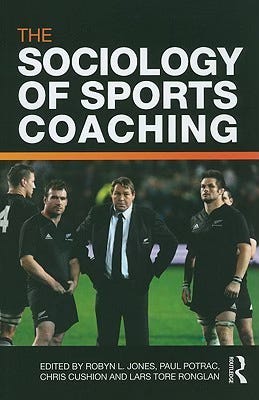
This book tackles some topics that transcend coaching but have profound impacts on how coaching is done. The chapter on the work of Michel Foucault contains this statement in the introduction:
…the aim is to outline some of Foucault’s key concepts, such as discourse, power and knowledge, and to suggest how coaches can develop new and innovative understandings of what coaching might mean by a consideration of how their knowledge of coaching and themselves has been shaped and formed by rules and conventions. (p. 28)
If I want to understand coaching better, I need to first provide a framework that will help me understand coaching better. The beginning of that framework is the recognition that coaching exists both within a larger context but also as a unique endeavor in itself. To understand this idea, the author uses Foucault’s concept of discourse. You can think of a discourse as a collection of ways of thinking, doing, and being that shape your experiences of the whole world as well as specific parts of the larger world.
When I say coaching exists as a unique discourse, I mean there are ways of thinking, doing, and being that only make sense within the context of coaching sports. For example, in volleyball, the term “set” is used in two different ways. Coaches and players rarely need to stop and explain which one they mean because, to them, the context is usually quite clear. To non-volleyball people, the difference between the terms might not be clear at all.
When I say coaching also exists in a larger context, I mean there are many aspects of coaching that are influenced by broader systems elsewhere in the world. The nature of the relationship between coaches and players resembles much of the structure and expectations of teacher-student relationships. While some words, like “set”, have special meaning, others, like “learn” are used more or less the same way as they are elsewhere in the world.
You can call “seeking to understand coaching” engaging in discourse analysis. The authors frame it like this:
…it is important to identify how we have come to know how to practise [sic] coaching and how this knowledge works to assert the truth about coaching. In other words, discourses for Foucault were never real: they were socially constructed ways in which we ‘know’ about ourselves, our bodies and our practices. (p. 29)
That suggests that discourse analysis is far more than just simply defining words. Discourse analysis is a process of coming to understand who people can be and who they become as a result of being part of a particular discourse. Analyzing what coaching is or how it’s understood can take a lot of forms but the book chapter I’m digging into uses a specific kind of analysis, Foucauldian discourse analysis. That means the author was considering discourse through a very specific lens, that of power. The author quotes Foucault when defining power as “a relationship whereby the actions of some help to guide or direct ‘the possible field of action of others’” (p. 31). For Foucault, power is about relationships and how different people can influence what others think and do.

The Roadrunner and Wile E. Coyote engage in a specific discourse. They both agree to participate according to certain rules. (Wile E.’s agreement is implicit in his continued pursuit of his adversary. What if he just walked out of the frame instead?) The rules allow them to (briefly) defy the laws of physics. The rules also doom Wile E. Coyote to constant defeat. While both characters have the power to act as they choose, only one of them is allowed to succeed. This, Foucault tells us, is how rules (power) construct “truth”.
I put “truth” in quotation marks because it emphasizes that truth is not nearly as objective as we assume. The key idea is that truth is socially constructed, in the real world as well as in cartoon worlds. But not everything can be contested in the real world. You can’t socially construct your way out of the effects of gravity, for instance, no matter what Wile E. Coyote might want. But you can (and do) socially construct your way into almost everything about coaching.
…the discourse that produces the truth that planning athletes’ training is a rational and technical practice survives quite effectively, even though many athletes turn in outstanding performances despite deviating from their coaches’ so-called scientifically derived training plans. Likewise, many athletes perform disastrously despite following their coaches’ plans to the letter. This ambiguity illustrates how discourses, as Foucault (1980) would say, are by no means true but how, through a range of complicated relations and taken-for-granted practices, they come across as if they were natural laws or facts. (p. 30)
Denison is saying that what “coaching” is, is agreed upon, usually without much notice, by coaches and athletes. That agreement becomes the “truth”. Coaches demonstrate their agreement with what coaching is by acting in certain ways, like having players warm up before practice or competition. Players demonstrate their agreement with what coaching is by participating in the warm up. This is an example of power being about how one person or group can influence what another person or group thinks and does. The coach does something because they think it’s objectively true and players follow the coach because they believe the coach is always right. But players also follow because coaches don’t like coaching players who don’t agree with them.
While power may be unequally distributed between coaches and players, it is important to note that neither group is powerless. Just like Wile E. Coyote, there is some power present, even if it isn’t exercised in a contrary way. For instance, if a player doesn’t agree with the assertion that warming up is useful, they could arrive late to practice to avoid warming up. And, even though coaches typically hold more power than players, they are simultaneously in relationships in which they hold less power. For instance, coaches are regularly subjected to coaching orthodoxy. If a coach uses an “unconventional” warm up, the coach ends up answering endless questions about their competency and/or being told to change the warm up.
Some might call what coaches and players feel “pressure”. We can talk about pressure being exerted on the coach to change and conform. But, according to Foucault, it would be more accurate to think of influence rather than pressure. For Foucault, pressure suggests outright control of the discourse. But coaches may not see themselves as being pressured and, instead, see themselves as maintaining the status quo and answering to the requirements or the standards of coaching. Coaches want to maintain the status quo because doing so helps them feel competent. That’s the difference between pressure and influence, the person agrees to conform on their own.
I’ve mostly kept the focus on how coaches are subject to power in how they choose how to coach. And, believe me, that can give you enough to chew on about how you choose to coach. But what I think about even more is how coaches’ power is silently shaping how others experience their coaching, sports, learning, competing, and, ultimately, how those others experience themselves. I can’t stop thinking about this quote from the chapter: “Sport in this sense, as practised [sic] by many coaches, can be thought of as a modern discipline that is ‘both an exercise of control and a subject matter’ (Shogan, 1999: 11)” (p. 32).
It’s virtually impossible for me to coach purely subject matter when I see power everywhere. I can’t watch others coach and only see how they coach skills while ignoring how they use power. You are never teaching just subject matter. You are always exercising control and, therefore, teaching others how to respond to that control.
That’s where I’ll pick up in part 2.

Jones, R. L., Potrac, P., Cushion, C., & Ronglan, L. T. (2010). The Sociology of Sports Coaching. Routledge.