
The "Politics" of Coaching (part 1)
Sociology of Sports Coaching #2.1

I’m always trying to read books that stretch my thinking about coaching and learning. I recently read two books that stretched me a lot so I am writing about concepts from those books for two reasons. First, I don’t think these books are widely read so if I don’t share them with you, I don’t know that anyone else will. Second, selfishly, writing about these concepts helps me think through what they mean to me and how I could incorporate them into my own coaching. I see these as opportunities to wrestle with some big ideas in front of others. I hope you find these explorations both interesting and edifying.
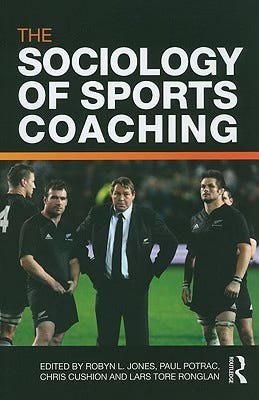
The concept below comes from The Sociology of Sports Coaching edited by Robyn Jones, Paul Potrac, Chris Cushion, and Lars Tore Ronglan1. Specifically, this concept is taken from chapter four, “Pierre Bourdieu: A theory of (coaching) practice”, written by Chris Cushion.
The quotation below sets the stage for this discussion.
Because coaching can be readily represented as individual ‘episodes’, it is too easy to overlook how the interrelatedness and interconnectedness of such ‘episodes’ create and sustain a social process (Cushion, 2007). As a result, it becomes (and has become) easy to take an asocial linear view of coaching (Cushion, 2007; Cushion & Lyle, 2010). (p. 42)
Cushion is saying that coaching is often treated as a collection of skills, drills, and competitions. According to this view, coaches can take individual drills, games, and ways of performing skills, mix and match them, and call it coaching. The problem with this, Cushion points out, is that coaching loses its connection to the people that are being coached and to the people doing the coaching. It becomes a thing coaches do to people instead of a thing they do with people. The social aspect of coaching is crucial because coaches and players aren’t things, they are people and people inevitably relate to one another in different ways as they do things together. People have things they value and those values impact how they do what they do together.
I’m going to cheat and include a quotation from a different book, but I think it provides a crucial perspective. I read this quotation from linguist James Paul Gee several years ago and it has stuck with me ever since.
Social goods are the stuff of politics. Politics is not just about contending political parties. At a much deeper level it is about how to distribute social goods in a society: who gets what in terms of money, status, power, and acceptance on a variety of different terms, all social goods. Since, when we use language, social goods and their distribution are always at stake, language is always ‘political’ in a deep sense.2
Although Gee is referring specifically to language, the quotation makes the larger point that all our social activities are “political” because social goods are involved. Gee refers to “money, status, power, and acceptance” as social goods and that connection is perhaps the most important lesson in the chapter I’m discussing here. As Cushion states at the end of his chapter,
Importantly, coaching and coach education cannot be viewed as neutral, nor are they devoid of political content. (p. 53)
So how can people make sense of the politics of coaching? As the title of the chapter indicates, Pierre Bourdieu created frameworks to help explain. The sociologist had three areas of focus that, together, shed light on how social goods are distributed and contested in coaching. Those three areas are habitus, capital, and field.
Habitus
The word habitus closely resembles habit, and with good reason. It describes actions people take that are expressions of who they are, what they believe, what the their history has disposed them towards, and what they see in the situation they’re in. You can see that habitus may be part habit, but it is also much more than that. As Cushion writes,
Bourdieu defined habitus with typical verbal flair as ‘the product of structure, producer of practice, and reproducer of structure’, the ‘unchosen principle of all choices’ and the ‘conductorless orchestration of conduct’ (Wacquant, 1998: 221) (p. 43)
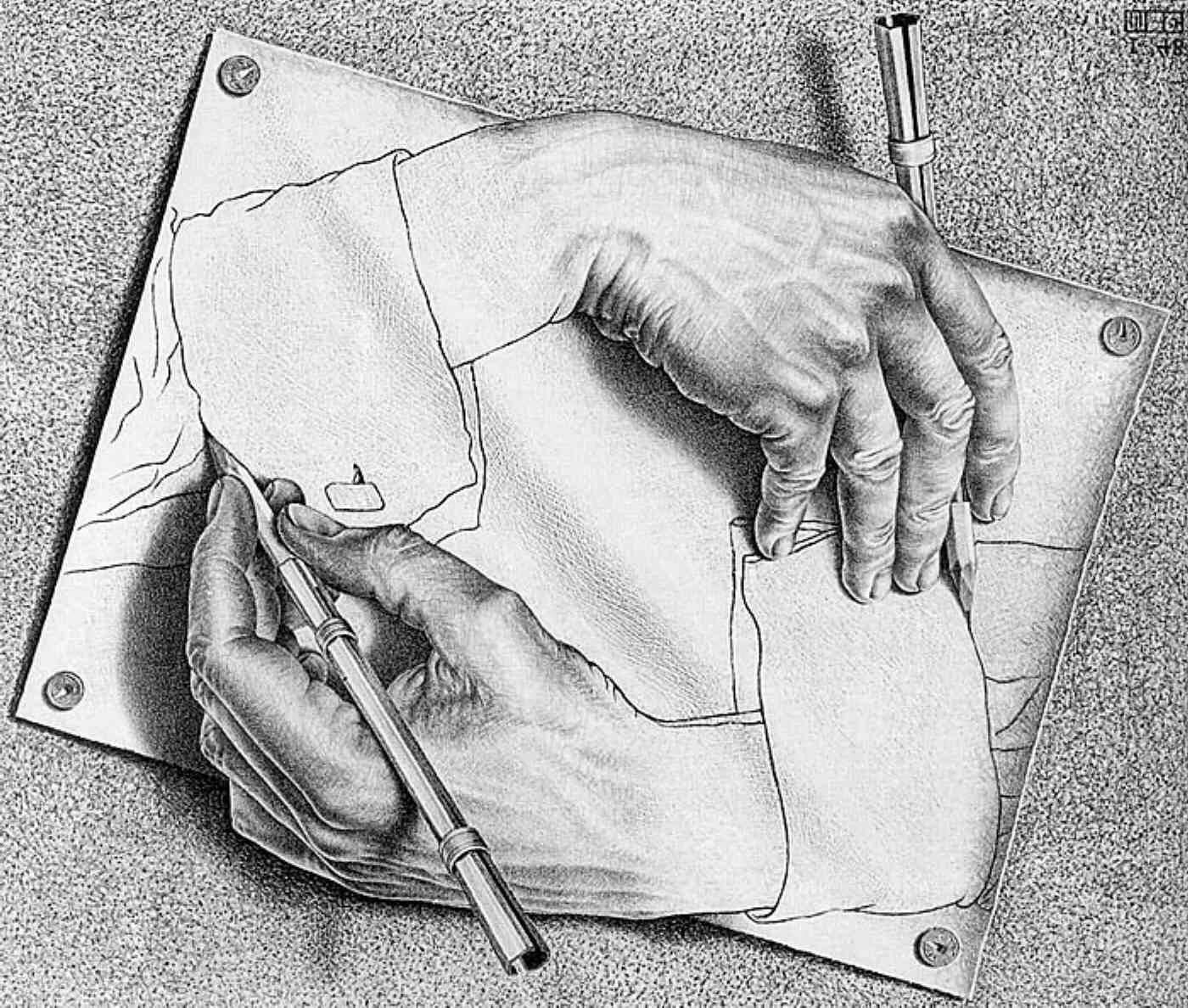
There’s a circular nature to what habitus is and how it is expressed. It reminds me of the M. C. Escher piece, Drawing Hands. Habitus is both a creator of structure as well as a structure itself that is created. Habitus is part of a feedback loop in which it is simultaneously both cause and effect. One hand draws the other into existence.
But those descriptions might not have given you a clear idea of how habitus actually shows up in you and in your coaching. I don’t know if it’s possible to easily sum up habitus, but I’d start with two words: structured improvisation. Every practice, every competition is at least a little bit planned and at least a little bit made up. That’s not exactly what habitus is, but it gives you a great way to relate.
What makes the structured improvisation of habitus different than that of practice and competition is that the structure of habitus is mostly invisible. It is the “…combination of a social actor’s deeply ingrained identity and his or her less fixed, occupational identity (Meisenhelder, 1997; Everett, 2002)” (p. 44). The improvisation flows out from these identities. It is improvisation because the combination of identities and moments is ever-changing. Improvising based on that structure creates new understanding and new possibilities for action that become part of the structure that then gives rise to new improvisation.
Habitus is both how you act and what has shaped your choices and actions. But it is not formed or reproduced in a vacuum. Habitus is a product of and a producer of social practices and structures. And Bourdieu saw additional factors that also influence and impact social practices.
Capital
Like the habitus/habit similarity, the second piece of Bourdieu’s frameworks uses a word that calls to mind other meanings. You may be familiar with capital as it relates to economics, where it refers to the means to acquire goods and services. When Bourdieu talks about capital, he’s talking about the means to acquire social goods.
Gee referred to money, status, power, and acceptance as social goods that are always at stake in social interactions. Bourdieu refers to several forms of capital:
Economic (that which can be immediately and directly converted to money)
A pro contract is a form of economic capital
Cultural (such as educational credentials)
Knowing specialized language about your sport is a form of cultural capital
Habitus is closely related to cultural capital
Social (such as social position and connections)
Wearing popular clothes and shoes is a form of social capital
Symbolic (from honor and prestige)
MVP and All-American awards are forms of symbolic capital
Being seen as “coachable” or credible are also forms of symbolic capital
Having capital gets you power so many social interactions are driven by the desire to either demonstrate the capital you possess or gain capital. Different people may pursue different forms of capital in the same situation. The same person may pursue different forms of capital in different situations. It’s all very context-dependent, with people ranking the importance of different forms of capital in various ways. People leverage one form of capital to gain more of another.
A coach can portray themselves as knowing a great deal about coaching a particular skill when talking to players (cultural capital) but then choose to portray themselves an knowing less when talking to another coach (symbolic capital). A coach can leverage a conference coach of the year award (symbolic capital) into a better contract at another school (economic capital). A player may emphasize how much their team likes them (social capital) to convince their coach to select them as team captain (symbolic capital).
Coaches, players, and other stakeholders are constantly cooperating and competing for social goods. You can be positive, you can be negative, you can (very rarely) be neutral. What you can’t be is outside of it all:
Coaching, therefore, needs to be understood not as a nonaligned or dispassionate social space, but as one that creates and recreates difference (Nash, 1990); a space where the bases of identity and hierarchy are endlessly disputed and contested. For example, both coaches and athletes when initially entering a sport or sporting environment have limited social gravitas. They thus immediately strive to accumulate symbolic and cultural capital to guarantee status. (p. 45)
Who you are and what you value is constantly being shaped by the coaching you do as well as where, when, and who you are coaching. Capital is just a way of framing some of the factors that shape your coaching world.
Bourdieu has one more concept that affects coaches. While habitus and capital are fairly easily understood in terms of an individual and in terms of one-on-one or small group (e.g.: team) interactions, the concept of field helps coaches understand the larger context within which coaching happens. That’s where I’ll start part 2.

Jones, R. L., Potrac, P., Cushion, C., & Ronglan, L. T. (2010). The Sociology of Sports Coaching. Routledge.
Gee, J. P. (2014). Language as saying, doing, and being. In Angermuller, J., Maingueneau, D., & Wodak, R.. The Discourse Studies Reader: Main currents in theory and analysis. John Benjamins Publishing Company.