
The Romo Effect - A Post Script
TV Production Is Hard...

After what might be called a rant about volleyball broadcasts, I want to make something clear: I don’t know much about how volleyball broadcasts actually work. But I know more about them today than I did when I first presented the material in The Romo Effect. I had an opportunity to meet with an executive producer for LOVB’s matches and then be in the control room during some matches to see how it all happens. (I am thankful to everyone involved for their willingness to share their time and their insights on such a busy weekend.)
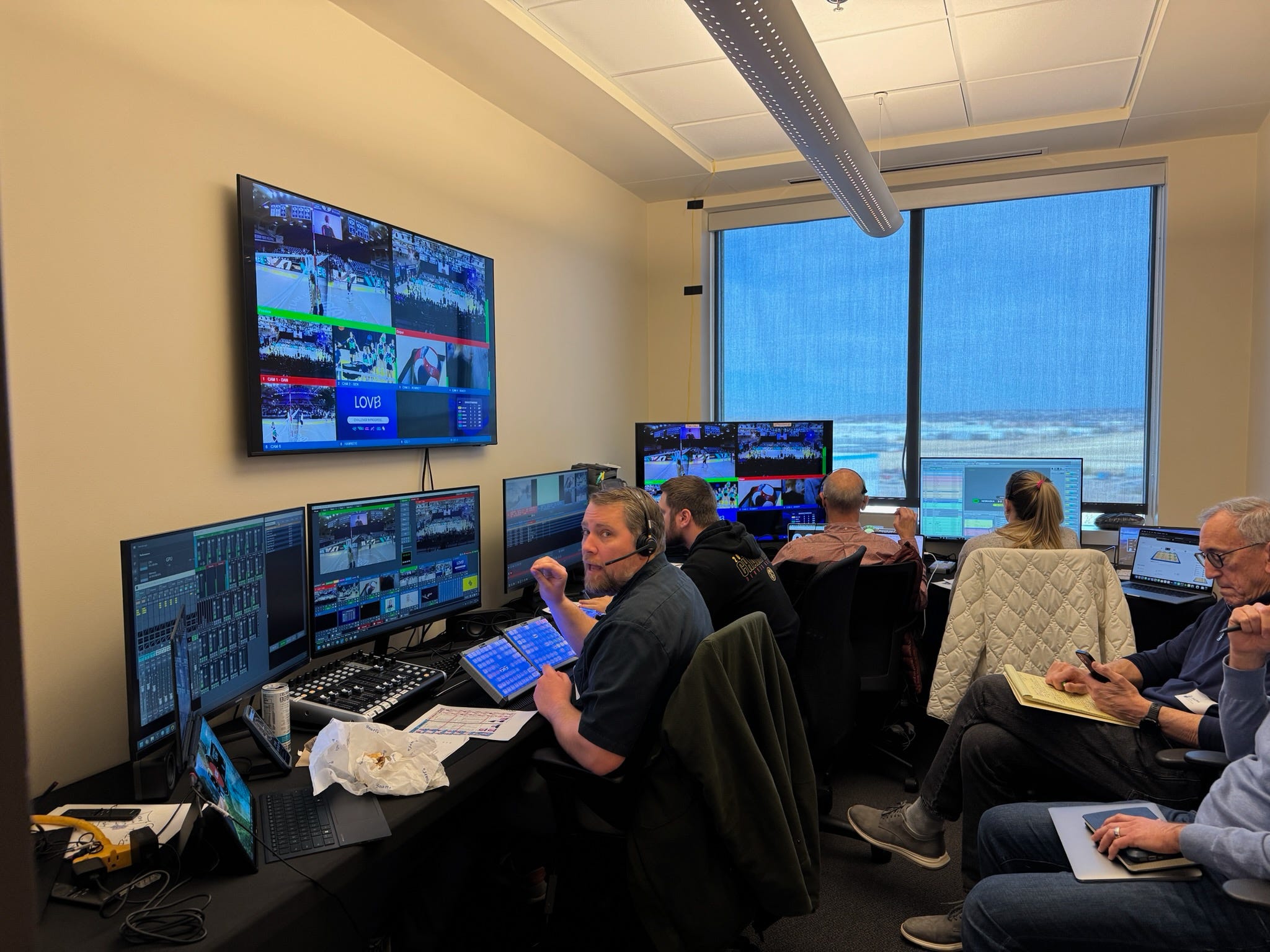
While I learned a lot about what goes into a volleyball broadcast, I also learned that the building blocks I discussed in The Romo Effect can work. It is clearer to me now what it will take to make changes to broadcasts. But that gain in clarity comes with a cost: “clearer” doesn’t mean “easier”. Here’s a quick summary of what I’ve been thinking about since then.
There’s knowing volleyball, there’s knowing broadcasting, and then there’s knowing volleyball broadcasting. What’s interesting to me is how little overlap there is (or needs to be) in order to produce and broadcast a volleyball match. As much as I wish it were different, I’m not upset about that. Because…
The people working on these matches love producing, directing, and broadcasting sports. If they loved volleyball as much as I do, they’d be sitting where I am instead of where they are. It’s not fair for me to ask them to care about my thing the same way I do. (I wrote about that concept in a coaching context here.) But…
If they care about doing their jobs well, there are opportunities aplenty to learn more about the sports they cover. The problem is the way volleyball broadcasts are produced makes learning more about the sport really hard. Because…
Everyone working on these broadcasts is freelancing. They’re busy trying to fill their schedule with jobs so they can make a living. Given the time they have, it’s hard to go deep on anything other than the job itself. If they want to get work, they need to ready for any job, not just the ones in some sport they happen to also be a fan of.
What would help? There’s at least two options:
Keep production crews together for multiple events. That’s what you get in NFL broadcasts (among others). While NFL crews are broadcasting different matchups every week, they at least stay together and that gives them opportunities to figure some things out because they at least know who’s with them and what they’re doing every week.
Bring a domain expert into the process. Having someone who understands volleyball and understands at least a little about broadcasting in the meetings (and probably in the control room) could help those less familiar and support those that already know more. While having volleyball experts (like coaches) work as broadcasters can be good, a broadcaster’s job is not to influence the broadcast the way someone can if they’re in the control room instead of the broadcast booth. But…
To no one’s surprise, these ideas require more money than is currently available. As it is, the broadcasts I watched were run by what might be the minimum number of people possible. I don’t know how likely it is to see more money invested in volleyball broadcasts in the near future, but I’m somewhat optimistic. It remains to be seen how producers and executive producers would spend such extra money, but there’s probably a long list of things they want that are probably more important than my ideas.
How do factors like those listed above impact the implementation of the building blocks I outlined in previous posts?
Ease of access to stats is still a major issue. Watching pro broadcasts helped me understand that not everyone has access to the same stats. College broadcasts have a more robust infrastructure to rely on, namely the sports information departments at each university. But, even with that infrastructure…
Data gathering and analysis is largely ad hoc, meaning that it depends on who is working. If the producers and the broadcasters are more interested in analysis, then maybe more analysis happens. But there’s no guarantee that much of the analysis will make it on the air if one of those two groups isn’t as interested or comfortable. Further…
Incorporating more/different stats into broadcasts requires work from at least 3-4 people: the producer, the graphics person, and the broadcaster(s). Not only do producers and broadcasters have to care about which stats are being incorporated, but having those stats appear on screen would be tremendously helpful. That means the graphics person has to have access to them, the producer has to ask for them, and the broadcasters have to talk about them when they’re displayed. If any one of those three things doesn’t happen, stats are unlikely to survive in the broadcast. What would help stats survive?
Stats need to be portable. Portability in metrics means a stat is “stable between contexts that everyone from different contexts can understand.” (I took the idea of portability from C. Thi Nguyen.) Kill percentage is more portable than hitting efficiency because you don’t have to worry about what is or is not an attack error. Portability is important because broadcasters don’t have to spend time explaining things that are highly portable. Reception average isn’t very portable, unfortunately, because it requires a great deal of context to understand and implement. Why do stats need to be portable? Because…
All of this discussion is overshadowed in many ways by another factor that came up constantly in my meetings: time. For at least 30 years volleyball, both in the US and across the world, has been making accommodations to make the game more attractive for television. Many of these accommodations have been aimed at making match length more predictable. But television has been changing too. While producers and executives would like to have matches fit into neat time slots, fitting isn’t nearly as important as it used to be. Linear television networks have “spillover channels” that can begin coverage of an event that’s been preempted by another event running too long. Streaming content negates the concern for overlapping programming completely. So time isn’t at the same premium it was even five years ago.
And yet, volleyball, both pro and college, are incorporating a serve clock into matches. I watched the production crew be left behind by a challenge that was resolved before they even received the video feed from the challenge review system. They were desperately trying to show viewers what had happened but the delay in delivery of the video, coupled with the speed of the review and the pressure of the clock, left them no choice but to cut away from the review to go back to live action. I credit the officials for a speedy review, unlike what is often seen in challenges. But the officials have no choice after they complete the review but to move on with the match.
For reasons and situations like those above, the producer we met with isn’t a fan of the serve clock or other moves meant to speed up the game by minimizing time between rallies. I agree with them. It makes it a lot harder to tell any kind of stories in any kind of depth when there’s so little time in between rallies to tell those stories. Could better things be done with the existing time? Sure, but the current format is handicapping broadcasts in that regard. I don’t know how to navigate the tradeoff between how long a match lasts and how much storylines can be developed. I do believe this tension must be addressed.
I am hopeful for a future in which broadcasts are able to tell more stories about how matches are being won and lost and that they include more stats that connect better to how teams won and lost. One reason I am hopeful is a conversation I had with one of the broadcasters about kill percentage and points. They asked great questions about how those stats were better than what they were used to using. And then they listened intently as I showed them an example (set 3 of the 2025 NCAA championship match) of how kill percentage and points could give a clearer explanation of why teams win. They saw the value of those stats in telling the story of a race to 25. It’s moments like that give me hope that we can bring about positive change that will keep volleyball fan engagement growing.