
You're Ruining Mindfulness with How You Do It
Ronald Purser's McMindfulness - A Short Reflection

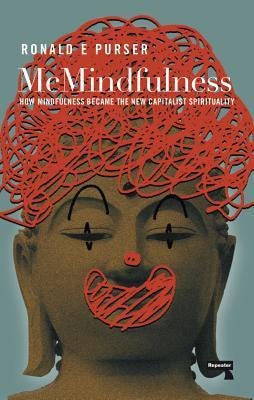
Society has a mindfulness problem. But it isn’t the one you would think of, or that popular culture and media would have you think of. It is the most ironic of mindfulness problems. You think you know what it means to be mindful: to be aware, to be present, to be in the moment. You’ve listened to countless soothing voices remind you to bring your attention back to your breath. But for what, exactly?
I certainly don’t take the position that mindfulness serves no purpose or that it doesn’t have any benefits. But I do agree with Ronald Purser’s main claim, that mindfulness is supposed to be rooted in something larger than yourself. I think that having clarity and focus is important but why should you seek to be clear and focused? McMindfulness teaches that your thoughts are a problem that needs solving or fixing. You are supposed to be mindful so you can be in control of your thoughts. Purser shows how mainstream mindfulness has incorporated the Protestant work ethic to its detriment. That work ethic tells you that you can achieve anything if you work hard enough, but when you apply that to mindfulness you drive yourself to be mindful only of yourself. You learn that controlling yourself is all you need to do. But that, says Purser, is not what mindfulness is.
The author makes many incisive observations about how McMindfulness has neutered what mindfulness is meant to be and about how mindfulness has become a tool of corporate interests. And while I agree with his arguments, I can’t provide more or better insight about those areas. What I want to share are my thoughts on how McMindfulness has influenced how coaches function and how they interact with others, especially athletes in their care. As coaches are wont to do, they have taken a complex framework and turned it into a drill they do in practice. Coaches have flattened the contours and nuances of mindfulness into a thing that they can plug into their practice plans rather than keep the complexity and have it change how they view coaching.
To be clear, I think that a simplified version of mindfulness is beneficial in sports and performance. While my interest in ecological dynamics and related theories of skill acquisition may lead to differing opinions of what coaches and athletes should be mindful of, I still think that both groups can free themselves to perform better by applying ideas of mindfulness. The issue is that mindfulness means so much more than “just focusing” and I can’t turn away from that. It is meant to have you better understand your place in the world, not just your place in the game. It is meant to position you to do something about the conditions you see in the world. When you use self-awareness mindfulness techniques divorced from their roots in social and community awareness, you miss the point of mindfulness. In McMindfulness, you use these techniques to slow your thoughts but you do so to make space for small actions like jumping higher and moving quicker or “better”. Purser is reminding you that the purpose of stillness of mind is to give you more clarity on what exists around you and how you are perceiving and interacting with everything outside of you but you can only do that by first making space within you. You can then use that space to be part of big actions too.
So are you using mindfulness in teams to help you do something to some object like a ball? Or are you using it to do something with those around you? Are you using it to be better coaches or better teammates and better humans? I don’t think you should just do a minute of focused breathing so that you are better at ignoring external “distractions”. I think you should use the breath as a way to see your team and your place in it more clearly. I won’t mistake a feeling of stillness for a feeling of peace. To me, the peace comes not from a quiet mind but from right living. The breathing gives me a chance to reflect on how I am living. I can see if I am working together with my teammates in meaningful and positive ways. Part of that reflection may be that I need to do my job better but I think that should come after the reflection on how I am integrating with my team. If I can’t or won’t be mindful of my part in the larger whole then I am putting my ego before all else, which is antithetical to a mindfulness practice.
I also think that using mindfulness practice is an opportunity to create awareness of things that exist outside of your teams as well. I think that you should be asking yourself how your coaching and their playing sports makes an impact on the larger community and the world. How can you use who you are and what you do to be a meaningful part of your community? If creating stillness and peace within yourself and your team means that you must do work outside of sport then I think you have taken Purser’s words to heart. I am not saying that sport should only be an avenue to social justice but I do want to say that mindfulness in the Buddhist tradition means that all of these lie along the same path.
I have been thinking lately about the communities in which we practice: our teams, our opponents, our spectators, our histories, our futures, and ourselves. I have been wondering what it is that we are creating, recreating, reproducing, passing on, and adding to. When we say we want athletes in our care to grow and develop, what do we want them to grow and develop towards? How do our daily choices and actions contribute to that? How can mindfulness be part of that vision? Let us meditate on that.