
Learning Is More Than Doing, Mentoring Is More Than Answering Questions
Sports Coach as Educator #2

I’m always trying to read books that stretch my thinking about coaching and learning. I recently read two books that stretched me a lot so I am writing about concepts from those books for two reasons. First, I don’t think these books are widely read so if I don’t share them with you, I don’t know that anyone else will. Second, selfishly, writing about these concepts helps me think through what they mean to me and how I could incorporate them into my own coaching. I see these as opportunities to wrestle with some big ideas in front of others. I hope you find these explorations both interesting and edifying.
The concepts below come from The Sports Coach as Educator edited by Robyn Jones1. Specifically, they come from chapters 9 (“The coach as a reflective practitioner”, written by Wade Gilbert and Pierre Trudel) and 10 (“Mentoring - Harnessing the power of experience”, written by Chris Cushion).
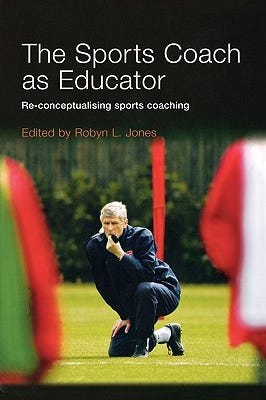
Here’s a passage from chapter nine to set the stage:
What is troublesome with learning to coach through experience is that we do not know what it really means. Is learning through experience as simple as only spending time in the field? For Bell (1997: 35) this ‘is not the case. To become better skilled at one’s professional practice, a novice teacher or coach needs to do more than simply spend time on the job’. (Jones, 2006: pp. 113-114)
There are two elements of this passage that I find noteworthy. First, Gilbert and Trudel are saying that a novice coach, left on their own, will have difficulty understanding what their experiences mean. Second, when they quote Bell, they say that just coaching isn’t enough for novice coaches to adequately learn the craft. They’re alluding to a very important tool in learning to coach: reflection.
I have written elsewhere about the importance of reflection in coaching. (Read more here and here.) Just like Gilbert and Trudel, I rely on the work of Donald Schön to describe how coaches can reflect on their work.
Let’s take the first point Gibert and Trudel raise in the quote above. Coaches in general are left to practice their craft in relative isolation. This can be problematic for less-experienced coaches, even if they have good practice plans or other resources. Being left to one’s own devices does lead to some learning, but that process is wildly inefficient because, as Gilbert and Trudel point out, such coaches have no experience to recognize and interpret the meaning present in the situations they participate in. There’s plenty of feedback present, but no framework to help them interpret that feedback.
The authors write that coaches can get more out of their coaching by reflecting on the coaching they do, but that process is still slow and sometimes painful because there’s still no framework for assessing the coach’s work. I believe it takes coaches so long to achieve mastery because they are forced to learn the most important lessons alone and because the resources made available to them are focused on less-important lessons. This is where mentors can be immensely helpful. But even having a mentor is no guarantee of improving the learning process.
Reflection and mentorship must work together to create better learning, otherwise learning is limited. Gilbert and Trudel describe it like this: “if mentors are not reflective coaches they will only transmit to the apprentice-coach the knowledge-in-practice and their own routine” (p. 125). When a mentor tells an apprentice what they know and what they do, the mentor does nothing to help the apprentice understand what prompted the choices the mentor made. According to Schön, this happens because “In real-word practice, problems do not present themselves to practitioners as givens. They must be constructed from the materials of problematic situations which are puzzling, troubling, and uncertain” (Schön, 1984: 40). The apprentice doesn’t need a solution so much as they need to make sense of the problem.
Mentors, then, should help apprentices recognize the situations they are in. To create opportunities for this kind of mentorship, Gilbert and Trudel suggest having “…mentors attend the coach’s practice instead of the apprentice-coach entering the coach-mentor practice” (p. 125). Generally, apprentices show up to the practices of mentors rather than the reverse. But why not have the mentor see what the apprentice is actually encountering during their practices? The key is still for the mentor to describe their understanding of the situations that arise. This can prompt discussion between mentor and apprentice about the situations. As the apprentice comes to recognize situations, the mentor can begin to ask questions that will help the apprentice organize their thoughts.
But there is also great benefit to an apprentice being part of the mentor’s practices. The benefit doesn’t come from simple supervision, it comes from the mentor intentionally creating situations that give the apprentice access to different parts of coaching instead of overloading them with with everything a coach does all at once. Tod Mattox gave a great example of this when he talked with me about 46 Challenge: clipboarding (see the “who” section in the “depth” half of the post). The idea is to help apprentices limit their focus to specific aspects of coaching in order to help them learn parts of the whole in a manageable way. This is what Lave and Wenger call “Legitimate Peripheral Participation” and it is a central piece of Chris Cushion’s chapter on mentorship.

Coaching is a social and behavioral thing so participation like “clipboarding” involves immersion in not just what the coach is doing but into the entire community in which their coaching happens. Since coaching is a dynamic, contextual thing, the community in which it happens “…is not simply a repository for technical knowledge and skills, so a protégé needs more than just being shown ‘the answer’” (p. 134). A mentor doesn’t put an apprentice into a situation and tell them what to do, they put an apprentice into a situation and help them see what the situation requires of a coach. This gives the mentorship pair a rich set of experiences to reflect on and discuss.
Cushion writes about four different forms of reflection that mentorship pairs can utilize (p. 135). After each, I have added a sample question mentor coaches can ask to prompt discussion.
Technical examination of immediate skills and competencies (Which coaching skills did you use in the situation you were in?)
Descriptive analysis of performance, skills and competencies (How did you use those skills and how comfortable do you feel using them?)
Dialogic exploration of alternative methods to solve problems (Regardless of how successful you thought your behaviors were, let’s discuss a couple options you could have tried instead.)
Critical thinking of the effects of a course of action (What might some of the long term effects of your coaching in this situation be?)
Reflection and discussion in this style helps both mentor and apprentice coaches learn how to reflect on their own. But the forms of reflection above are focused on the apprentice’s behaviors. There’s still more important learning the mentorship pair needs to address. As Cushion writes, “The key for successful mentoring it would seem is to assist the protégé to become the focus, and to develop their abilities to analyse and draw meaning from the experiences that matter most” (p. 137). Deciding what a situation means is much more important than deciding what to do in that situation.
Why is meaning more important than doing? Because deciding what a situation means opens the possibility of not acting. Even though every moment may present an opportunity to “coach”, not every moment benefits from action on the part of a coach. (I wrote more about that idea here.) Learning to find the meaning of situations makes for better coaching.

What can mentors do to mediate apprentices’ meaning-making? They can share their own focus and purpose in a shared situation. When a mentor shares their focus, they help the apprentice know where to look and what to listen for, which helps them see what the mentor views as the salient parts of the situation without expecting the apprentice to interpret what they see the same way. When a mentor shares their purpose, it helps an apprentice understand what the mentor finds important to them in the situation without expecting the apprentice to adopt the same values. Mentors can also elicit perspectives from apprentices to help them crystallize their own philosophies.
What does an apprentice do with the meaning they find? They can use that meaning to begin answering the three questions that form the “logic of appropriateness” (March and Heath, 1994). (I wrote more about that process here.) As a reminder, here are those questions:
Question of recognition: what kind of situation is this?
Question of identity: what kind of person am I?
Question of rules: what does a person such as I do in a situation such as this?
The value of mentorship is not in answering questions asked by apprentices but in helping apprentices answer the questions above, posed by their coaching. Mentoring in this way helps coaches, as Cushion puts it by paraphrasing Snow (2001), “…not to ignore or downplay the personal knowledge and experience of the trainee (or perceived lack of it) but to elevate and build upon it” (p. 140). Apprentices may know little about coaching, but they know a lot about themselves and how they best communicate and connect with others. Mentors should highlight the importance of this understanding and find ways to help apprentices use it.
Cushion quotes Bloom to sum this up: “By doing this through a mentoring process, coaches could be given the opportunity to integrate information ‘relevant to crystallizing their own philosophies and unique coaching styles’ (Bloom et al., 1998: 278)” (p. 140). This should be the outcome of reflection and mentorship: an apprentice creating their own values and purposes instead of unknowingly and uncritically adopting the values and purposes of their mentors.
Jones, R. L. (2006). The Sports Coach as Educator: Re-conceptualising Sports Coaching. Routledge.
We love this article. It's a profound look at the hidden architecture of coaching. True mentorship is teaching a novice how to interpret the silence between the plays.