

Purpose can be defined as “the reason for which something is done or created or for which something exists”. Coaches love purpose. They love having a sense that they are made for something. They love feeling like they know why they coach. I think purpose is very important in coaching. But how do coaches believe they get purpose?

Coaches, like so many others, are taught that purpose is something to find. So they search for it. They search high and low, outside and within. But they’re looking for the wrong thing. They’re looking for something complete, a fully formed vision of what they are meant to do. Purpose isn’t something that exists somewhere, merely hidden from your view until you search intently enough to discover it.
Purpose is a thing you make. Purpose is a thing you build. Purpose is a thing you learn. You assemble your purpose, brick by brick. You discover what your purpose is as you build it. That means you make mistakes as you build it. That means you try out ideas that work in the short term but then discard them in the long term.
Purpose is not a static thing you can discover and then rely on for the rest of your career. You are continually making it and refining it as you find yourself in new situations and surrounded by new people. Your life changes. Your purpose should be able to change as well. You can have different purposes in different areas of your life and at different times in your life. That means you’re not supposed to figure it all out at once, nor are you supposed to figure it out for all time.

But why do coaches expect to find a purpose rather than build one? Because humans are social. Humans live lives of social comparison, relying on cues from others to interpret their own lives. The philosopher René Girard wrote about mimetic desire, or the wanting of things in order to mimic the wants of others. He wrote, “Man is the creature who does not know what to desire, and he turns to others in order to make up his mind. We desire what others desire because we imitate their desires.”1 To Girard’s way of thinking, people do not typically want something because it is inherently desirable. They want it because they see others wanting it.
Mimetic desire, which is a kind of social learning, can be useful, particularly for children and adolescents. They learn what is acceptable to like and to want as they learn to navigate the world around them. It can be said that novice coaches are like adolescents, entering an unfamiliar world and searching for cues from others about how to conduct themselves and in which directions they should point themselves. But I believe that searching for cues in others takes coaches too far. Doing so ignores that coaches aren’t children with no life experience. They have life experiences, just in other parts of life. When it comes to building your coaching purpose, your other life experiences count for something.
Novice coaches may not have relevant experience in practice planning or in drill selection but they have relevant beliefs about teaching, learning, and competing. If you leverage them, those beliefs can help you build your coaching purpose. Your beliefs are how you choose to be the noun, coach. Your purpose is how you choose to do the verb, to coach. They are connected.
Mark Manson talks about experimenting to build your purpose. He says, “Beliefs are theories, actions are experiments, emotions are feedback.” Your beliefs and your values are not your purpose, but they do help you construct your purpose. You can hold values and beliefs while you’re just sitting on the couch. But your purpose gets you off the couch because purpose is what gives your values direction. Your actions are shaped by your purpose. Reflecting on how your actions made you feel is feedback that suggests if you need to make changes in your values, your purpose, or your actions.
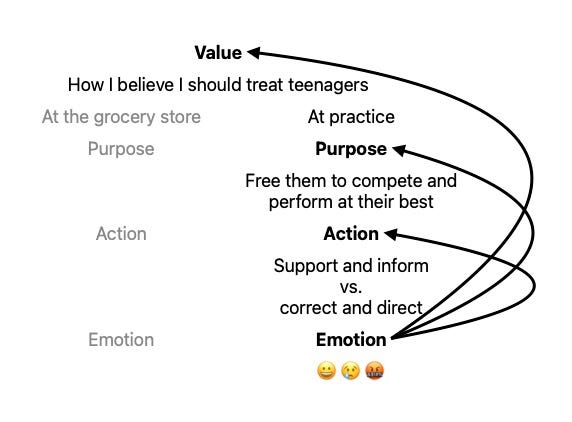
The example above uses my personal beliefs as a starting point to illustrate Manson’s outline. Regardless of what I do for a living, I hold some beliefs about how to treat teenagers. But I can have different beliefs about how I should treat them when working at a grocery store compared to how I should treat them when coaching. Because this Substack is called Inspiring Coaches, I’ll focus on the latter setting.
In practice, a purpose I abide by is freeing athletes to compete and perform at their best. My purpose helps me select the actions I use during practice. If I believe athletes should feel free to explore and compete, then directing their actions doesn’t fit my purpose. But supporting athletes in making decisions does fit my purpose. My purpose also helps me select activities that work in concert with how I want to coach within those activities. After practice, I reflect on how well I embodied my purpose and on how I felt as I coached. Those emotions are feedback about how well my actions represent my beliefs. Am I content with how I acted during practice? When I feel content, did I act in accordance with my espoused purpose? How I answer those questions helps me understand if my purpose and my actions are well-aligned with my beliefs as well as with each other.
So how do you build purpose? Mark Manson also poses some questions around building purpose. He asks, “What do you spend your time on that feels meaningful? How can you do more of it?” There’s a difference between what feels comfortable or easy or well-understood and what feels meaningful. I think that’s where many coaches get tricked by mimetic desire. They think meaning will emerge when they just do the thing but meaning comes from how you choose to do the thing.
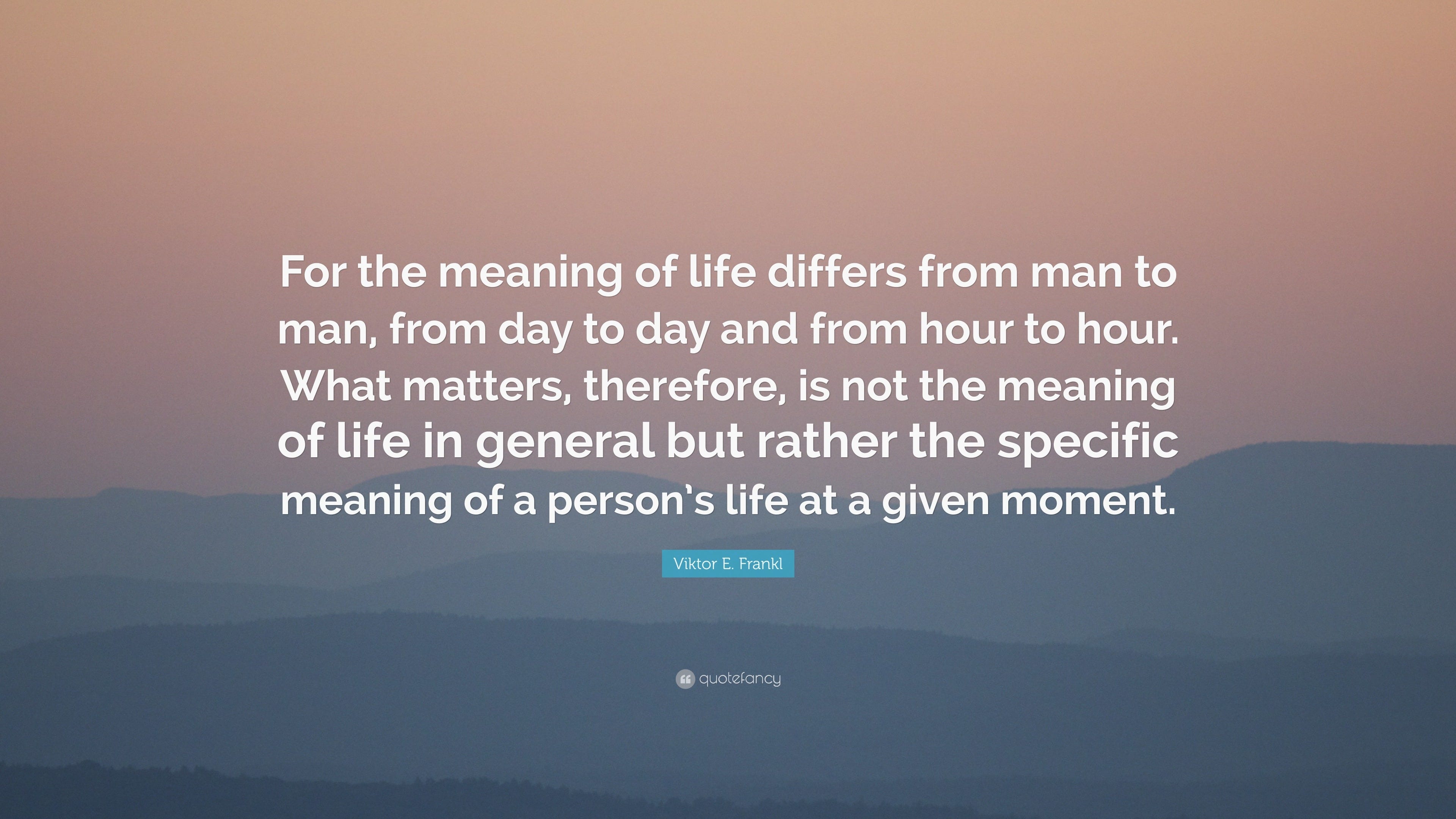
Less-experienced coaches do what they see others do but they don’t discover the hidden purpose that other coaches seem to have when doing the same thing. They are discovering what Frankl said about meaning differing from person to person. But when they don’t feel the same purpose, they question themselves rather than questioning the purpose itself. If you do what others do and you don’t feel the same, the problem isn’t necessarily with you, it’s possible their actions just don’t align with your purpose. You don’t have to change your purpose to mimic theirs. That misalignment is feedback and you can construct both methods and a purpose that suit you better.
So get back to the question of meaning instead of the question of fitting in. You’ll find that having meaning, having purpose, will give you the feeling you were looking for when you did what others were doing. To quote Manson again, “When people ask, ‘What is my life purpose?’ What they’re actually asking without realizing it is: ‘How can I use my time in a way that feels meaningful?’”
Purpose should not only give your values direction, but it should require action. As Manson and his cohost Drew Birnie discuss in their Solved podcast, “Finding Your Purpose” (link below), “Not only do you live out your purpose through action, obviously, but you also figure it out through action as well.” Your actions should bring you feelings of meaning, of personal significance, of authenticity. Those feelings (and the lack of those feelings) help you continually construct your beliefs and your purpose.
As I’ve written repeatedly (like here, here, and here), I believe I do my best coaching when I am most authentically me. There are many ways to find build your purpose. It requires work but it’s work you can and should do while growing your technical coaching skills. Ask yourself not just what you should do, but also ask yourself what you want to feel when you’re done.
Mark Manson’s Solved podcast, “Finding Your Purpose”:
Burkert, W., Girard, R., & Smith, J. Z. (1988). Violent Origins: Walter Burkert, René Girard, and Jonathan Z. Smith on Ritual Killing and Cultural Formation. Stanford University Press.