
The (Arrested) Development of Expert Coaching (part 1)
Sports Coach as Educator #3.1

I’m always trying to read books that stretch my thinking about coaching and learning. I recently read two books that stretched me a lot so I am writing about concepts from those books for two reasons. First, I don’t think these books are widely read so if I don’t share them with you, I don’t know that anyone else will. Second, selfishly, writing about these concepts helps me think through what they mean to me and how I could incorporate them into my own coaching. I see these as opportunities to wrestle with some big ideas in front of others. I hope you find these explorations both interesting and edifying.
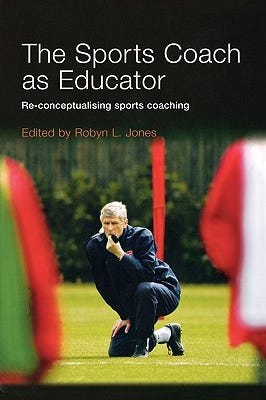
The concept below comes from The Sports Coach as Educator edited by Robyn Jones1. Specifically, this concept is taken from chapter eleven, “The development of expert coaching”, written by Paul Schempp, Bryan McCullick, and Ilse Sannen Mason.
I was inspired by this passage from the chapter:
Borrowing from the work of David Berliner (1994) in educational psychology, the purpose of this chapter is to describe the developmental stages in becoming an expert coach. Specifically, the skills, knowledge, characteristics and perspectives common to coaches as they pass from beginner, to competent, to proficient, to expert coach will be identified (Bell 1997, Berliner 1994). While these stages seem to imply a hierarchy, everyone passes from one to the next on the journey toward improvement. One can, however, choose where one stops in developing expertise. To help meet the new challenges of sport, these stages will be presented so that sport coaches may identify their current stage and recognize the skills, perspectives and knowledge necessary to elevate to the next level and beyond. (p. 145)
In the time I have studied coach development and reflected on the traits of coaches I encounter, I have had great difficulty achieving any kind of clarity around grouping coaches in a coherent way that describes how and how well they function. Much of my difficulty arises from a central problem: there doesn’t seem to be just one way to group them. I don’t think there’s a single spectrum coaches can be slotted into. I don’t think there are clear groups coaches fall into that describe who they coach, what they coach, how they coach, and what their goals are based on those other factors. I think it is possible to be a good coach doing good work towards good goals and still be seen as less than by other coaches that are doing arguably average work towards different goals. How is a coach developer to make sense of that?
I find the variety of ways the pieces can fit together both intriguing and frustrating. I love that there are so many ways to be a good coach. But how do I support developing coaches that are trying to assemble pieces in different ways than me? Their values and methods may be equally useful but not appropriate for who I am and how I want to coach. It’s one thing to tell another coach, “you’re doing it wrong” and help them find the right way. It’s something completely different to tell that coach, “you’re doing it differently” and give them expert guidance about how to coach their way. How do I communicate to them that they should keep doing what they’re doing, even though that’s not what I would do?
It seems that assessing coach development relies on some sort of absolute structure of coaching prowess and I can’t seem to decide on what that absolute structure is. Maybe there are elements that are universal, like similar behaviors that are applied regardless of differing values or situations. Those seem hard to find too. How specific can one get about what good coaching behaviors look and sound like before unintentionally introducing contexts that don’t apply universally? This is where “The development of expert coaching” comes in. The authors echo my thinking:
Simply knowing the characteristics and qualities of an expert is, however, not enough. Remember, too, that experts are individuals and their thoughts and actions often take on an idiosyncratic, at times eccentric, quality. Therefore, in considering the stages and the characteristics of each, understand that they represent commonalties [sic] among coaches rather than a prescription for being a great coach. (pp. 145-146)
The authors lay out a framework that tackles some of the issues I’ve been wrestling with. While I don’t think they have all the answers (or maybe even all the questions), they gave me a lot to work with and consider. As I said in the introduction, one of my reasons for writing about this book is to share it with others and another reason is to give me space to reason through what I’ve read. So I’m going to talk my way through their framework and hope that at least one of us benefits from doing so.
The first thing to do is lay out the “developmental stages in becoming an expert coach”. The authors use four stages: beginner, competent, proficient, and expert. Laying out these stages necessitates explaining what each one is. I’ll intersperse the authors’ structures with my own thoughts about them. I’ll begin at the beginning…umm…beginner.
Beginner Stage
Their conception of doing the job correctly includes following the organizational rules and procedures, particularly those centered on establishing order and managing the practice environment…This seems natural because through the naive eyes of a beginning coach, it is relatively easy to notice players on-task, listening, following directions and enjoying the experience. It is more difficult to discern athletes who are actually gaining knowledge, developing skills or improving performance. (p. 146)
The authors believe beginners are beholden to rules and procedures. They suggest beginners focus on them a great deal, use them extensively in their practices, and measure success by how well athletes appear to be following the coach’s rules. As a result of this focus, the authors continue, beginners “…seldom feel any personal control over the conditions and events of the practice and, therefore, may lack a sense of responsibility for their own actions” (p. 147).
I think their feelings of lack of control or responsibility are due, at least in part, to beginners’ lack of rules and procedures to control both themselves and the athletes. If they only had the right rules, they tell themselves, their practices would go better. So they go in search of rules to create the structure they think is necessary. I think this is expressed by beginner coaches asking more-experienced peers for drills and techniques. These are clearly procedures that less-experienced coaches can follow, which can give coaches that feeling of control they may be lacking.
What’s interesting to me (and highlighted by the first quote in the next section) is that coaches can be successful and potentially never leave the beginning stage. As a result, it feels strange to me to call this stage “beginner” if a coach in that stage can be well into their career. But what I realize is there are two ways you can view a career unfolding, in terms of time and in terms of development. A coach can work in the profession for years but not develop very much in that time. What is unconsidered, though, is the converse of that statement. Can a coach develop a great deal in a short time? Is a coach that does so considered a prodigy or can such a learning trajectory be more accessible than thought?
The authors describe the coaching world as it is but, at least in this case, they don’t consider if it could be different if coaches learned differently. Many people, including the authors, seem to work from the assumption that becoming a good coach takes time for everyone, everywhere. But what if you take the authors’ main assumption about beginners, that they desire rules and procedures to the exclusion of more helpful coaching tools, and help beginners see that desire as a limitation to their development?
Beginning coaches could be exposed to the traits and habits of competent coaches through deliberate, structured mentorship and teaching. Such facilitation would both accelerate learning and decrease frustration as coaches would spend less time acquiring rules and procedures, then finding those things aren’t helping them coach as they expected, then discarding those rules and procedures.
More on that in a moment. First, consider what beginning coaches need instead of structure. Consider what competent coaches do instead.
Competence Stage
As the authors lay out the second stage of development, they point out that many coaches “Despite having efficient management routines...never aspire to develop instructional prowess or help athletes learn” (p. 149). Coaches can remain in the beginning stage and still be...umm...competent. Such coaches are as successful as they choose to be. But, to move on to actual competence (at least as the authors define it), coaches move on from focusing on rules and procedures towards something else.
As beginning coaches accumulate experience, they begin to look to that experience to determine solutions and make decisions instead of simply following the rules and procedures they searched for previously. The authors refer to this as “strategic knowledge”. Such knowledge helps beginning coaches advance, and another piece of their advancement is a shift from being guided by rules to being guided by purposes. Being guided by rules means coaches expect the process to look the same, to look like what the rules dictate. Being guided by purposes makes the process more dynamic. This shift allows coaches to move from having to stick closely to their plans towards contingency planning which, according to the authors, is “if/then” planning. To them, competent coaches “see similarities across context” and can rely on their experience to choose what to do based on what they see.

The ideas of strategic knowledge and similarities across contexts give insight into the limits beginning coaches are imposing on themselves2. “Rules and procedures” can be thought of as algorithms. Algorithms are enticing to beginning coaches because they remove the need for expertise which, by definition, these coaches don’t yet have. The problem is expertise requires skill, judgement, and discretion. Coaching via algorithm allows coaches to avoid actually developing the expertise they need to become competent.
Another issue with coaching by algorithm is doing so requires stable environments. Following the same procedure in stable environment should get you the same results. But coaching environments are rarely stable, which leads to consistency in procedure but not in results. I think beginning coaches become competent coaches not when they focus on strategic knowledge but when they can reckon with the inherent instability of coaching.
Competent coaches reckon with instability by exchanging algorithms for principles. Contingency planning and other applications of strategic knowledge are examples of principles, which are different kinds of rules. Principles allow discretion and adaptability. Principles don’t have to be followed exactly the same way by everyone, everywhere, at all times. So, to exchange algorithms for principles, coaches have to let go of their expectations of stability and sameness.
That’s where I think there’s space for short-circuiting this inefficient way of developing. It is the duty of more-experienced coaches to disavow beginning coaches of the notion that coaching situations are stable enough to work in the way they imagine. Rather than allow beginners to build upon an imaginarily solid foundation, more experienced coaches can do more good for beginners by pointing out how contexts impact those imagined foundations. While there’s certainly more that experienced coaches could do, it would be enough of a start to do that.
This leaves two more stages and a lot more thoughts still to come. In part 2, I’ll enumerate proficiency and expertise, as well as dig into what I still haven’t figured out about coach development.

Jones, R. L. (2006). The Sports Coach as Educator: Re-conceptualising Sports Coaching. Routledge.
The paragraphs about algorithms, stability, and principles use ideas from Nguyen, C. T. (2026). The Score: How to Stop Playing Somebody Else’s Game. Penguin. Those ideas are interpretations of the work in Daston, L. (2022). Rules: A Short History of What We Live By. Princeton University Press.