
Coach Something That Means Something (part 2)
Sociology of Sports Coaching #3.2

(Title inspired by the 1995 Pharcyde track Somethin’ That Means Somethin’)
I’m always trying to read books that stretch my thinking about coaching and learning. I recently read two books that stretched me a lot so I am writing about concepts from those books for two reasons. First, I don’t think these books are widely read so if I don’t share them with you, I don’t know that anyone else will. Second, selfishly, writing about these concepts helps me think through what they mean to me and how I could incorporate them into my own coaching. I see these as opportunities to wrestle with some big ideas in front of others. I hope you find these explorations both interesting and edifying.
The concept below comes from The Sociology of Sports Coaching edited by Robyn Jones, Paul Potrac, Chris Cushion, and Lars Tore Ronglan1. Specifically, this concept is taken from chapter eight, “Etienne Wenger: Coaching and communities of practice”, written by Chris Cushion.

I ended part 1 saying if you want to get better at coaching, go coach with someone who can help you produce meaning in your coaching. Now I’ll dig into why I think that’s so important.


While you can learn by having co-participants with little knowledge, that makes you like the two blind men in the painting above. You are each trying to make sense of a situation while lacking some vital understanding of that situation. It’s incredibly valuable to have a mentor that can offer their understanding of not only the situation but also some understanding of your perspective. A mentor is at their most useful when they see what the learner sees and can verbalize how they understand what the learner is trying to understand.
…both mentor and protégé operate within an environment of shared enquiry and learning, with interaction revolving around ambiguity and dilemmas that emerge from practice settings (Cushion, 2006). Here, the mentor is often able to create meaning from protégés’ lived experiences that, in turn, become reinforced. (p. 98)
Co-participants influence the meanings each person takes away from each situation they experience together. (So the mentor also potentially learns too!) This is not a passive process, even if it isn’t entirely conscious. In the academic literature, the process is considered to be negotiated. That means you shouldn’t just ask a mentor what to do and then go do it without consideration. There should be a back and forth between you. There should be an opportunity for who you want to be to emerge instead of having your coaching style dictated to you by another person.
The process of negotiation makes meaning. It also makes you. This is a big reason why co-participation is so important in learning. Without it, you don’t form your own identity. Your identity is not just who you are in isolation, your identity is who you are in relation to others. You figure out who you are by seeing how you want to fit in and how you want to stand out. You figure out who you want to be by seeing how others respond to who you currently are.
“Building an identity in coaching means that coaches need to negotiate the meaning of their experiences as related to their membership of the [community of practice]. Alternatively, practice entails the negotiation of ways of being a person in that context (Wenger, 1998).” (p. 102)
There’s an interplay involved in learning and becoming a coach. There’s being a coach, and there’s coaching. They are interconnected, both of them are necessary. You have to do the verb and you have to be the noun. Your learning and your becoming are both part of doing the verb and being the noun. In fact, the relationship between doing the verb and being the noun is also negotiated.
For many novice coaches, their journey begins with being the noun. They are hired to coach because of their playing experience. Even though they have experienced what is often called the “apprenticeship of observation”, they have yet to do the verb, to actually coach. Doing the verb is vital to the development of a coach’s identity. It is by actually doing coaching things that one builds the concept of the coach they want to be. Even if you’ve read about or watched a video of something you’d like to do, it isn’t until you start doing it yourself that you feel what it’s like for that new thing to be part of what you do (and who you are).
Just reading about coaching or watching videos about coaching aren’t learning because neither brings meaning to being a coach or coaching. It’s not until you change your behavior that learning has taken place. If you read something (like a Substack post about meaning) and you go coach exactly as you had before you read it, then you haven’t learned anything. If, on the other hand, you read something and it helps you see yourself differently in coaching spaces, then you may change a decision or two while you are coaching. That’s learning. And it also demonstrates the connection between being and doing.
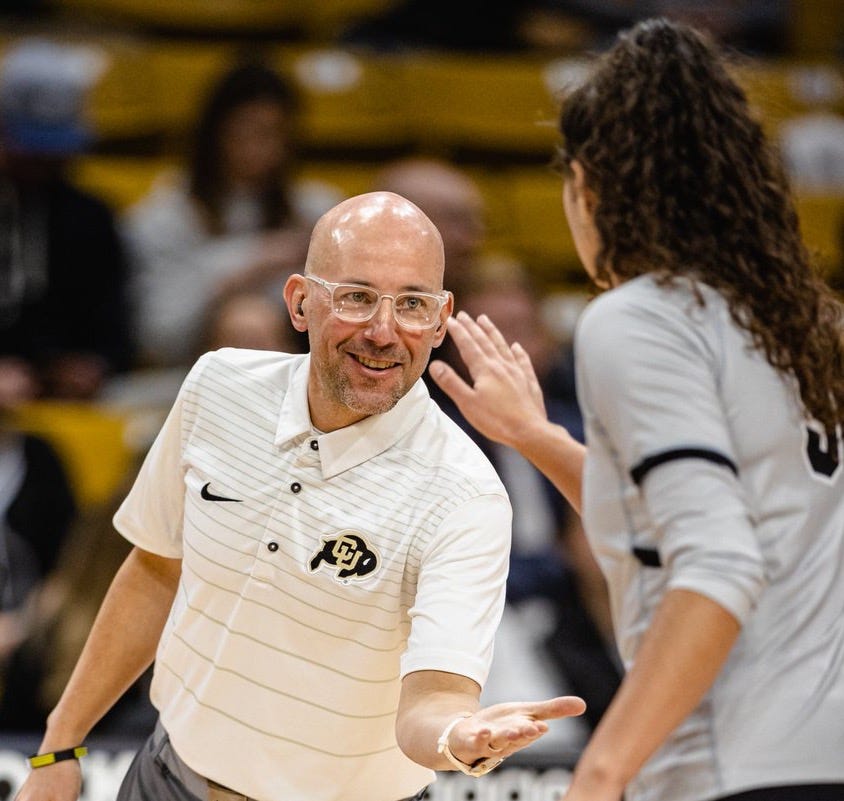
If you decide that you want to be someone a little different than you were when you coach, you’re changing the noun first. Maybe you tell yourself you’d like to be the kind of coach who wears golf shirts and buttons the top button. So you just start doing that when you coach. Maybe you tell yourself you’d like to be the kind of coach who doesn’t talk much to the team right after competition, instead saving your comments for a later time. So you just start doing that. The specific reasons for the changes aren’t the most important thing, what’s most important is that your reasons hold sufficient weight that they lead you to change your behavior. That’s making meaning.
But you can also change your behavior first and that leads you to change how you see yourself. That’s changing the verb first. Perhaps you notice you are using a drill or game much less than you used to. Perhaps you find yourself speaking differently to athletes than you used to. Upon reflection, you see that those drills, games, or words no longer reflect the person you actually are when you coach. While your behavior has changed, it isn’t until you reflect and create meaning for the behavior changes that learning has taken place. You create meaning by doing the verb. The meaning you create is what allows you to be the noun.
Learning is this interplay between doing and being. Who you are and who you want to be influence what you choose to do in your coaching and how you choose to do those things, and vice versa. All coaches, regardless of their experience, are always changing in some ways because they are always shifting what they do and who they are. Learning to coach, then, is a continuous process.
“…as identity, practice, participation and learning are connected, continual learning means that practice and identity are always under negotiation within a [community of practice]. In this sense, the coach is never ‘finished’, with the learning extending well beyond that gleaned from specific developmental episodes (Cassidy & Rossi, 2006; Hager & Hodkinson, 2009).” (p. 102)
Meaning creates the filters through which you process “new” coaching ideas. Who you currently are and what you currently do will shape your responses to new ideas you are exposed to. Those ideas are always all around you. They’re in the way you see others coach. They’re in how you feel as you’re coaching and how others feel as they are coached by you. They’re in your changing perspectives as you age and gain experience.
It would seem that you don’t need a mentor as you age, gain experience, and become better at understanding yourself but I argue that you do. A mentor reflects who you are back to you and presents you with ways to understand how you do the verb and how you are the noun. A mentor shows you things that are in your blind spots. They don’t tell you what to do with what they see, they create space for you to see it for yourself and create meaning for yourself. They teach you about yourself, rather than instruct you about who you should be or what you should do.
To sum all of this up, learning means changing what you do and who you are when you coach. Those changes arise because of the meaning you make. If you really want to keep learning and keep improving at your craft, you have to keep learning which means continually creating meaning for what you do and how you do it. Reflection and mentorship are two vital ways to do that.
Jones, R. L., Potrac, P., Cushion, C., & Ronglan, L. T. (2010). The Sociology of Sports Coaching. Routledge.